

RUPERT NEVE DESIGNS MBT | Master Bus Transformer

- Catalog #: MBT
MBT
Master Bus Transformer
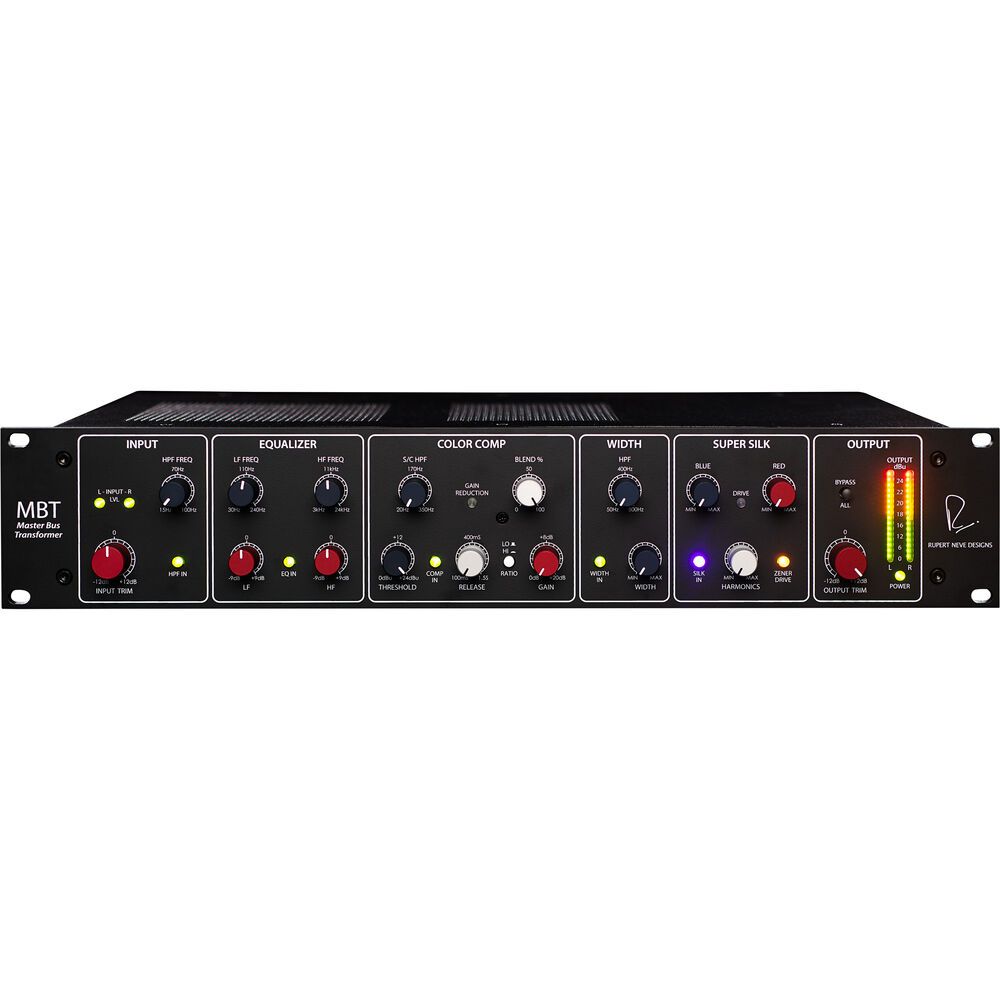
The MBT Master Bus Transformer leverages industry legend Rupert Neve's six decades of audio transformer expertise to provide a powerful and flexible audio processor uniquely poised to add an incredible array of flavorful options designed to sweeten, enhance, drive, widen, and utterly transform your source material, making it the ultimate tool for musical coloration. Equally at home on a full mix, groups, stems, or individual sources, the MBT pairs acclaimed tonal quality with an immensely flexible set of controls to shape your sound.
Create Tonal Magic with the HPF and Shelf EQ
First in line is a smooth high-pass filter with a fully variable frequency selection control. The HPF extends from 100 Hz all the way down to 15 Hz, an especially helpful area to manage on a full mix that needs to be as loud as possible.
Next up is the all-new 2-band Shelf EQ section—with 3 octave ranges, gentle slopes, and minimal phase shifts, this EQ was created with an emphasis on simplicity and elegance. This smooth and musical EQ is excellent at providing just the right amount of tonal enhancement—especially when it is interacting with the other sections of the MBT.
Each band has +/- 9 dB of gain control, with the LF EQ corner frequency variable from 30 to 240 Hz and the HF EQ corner frequency variable from 3 to 24 kHz. The LF band is excellent at either taming or accentuating low-end to give source material an exacting amount of weight and power. The HF band provides a wide range of corner frequencies to choose from, allowing adjustments to be made from the upper midrange all the way up to the very top end, giving tracks extra shine and clarity.
One exciting aspect of using the MBT is discovering how the different sections can interact with each other. Sometimes the EQ can be dialed in first, other times it can be left alone until the other sections are dialed in. One thing is certain: the MBT encourages experimentation at every turn.
Breathe In New Life with the Color Comp
With an all-new optical compressor design, the Color Comp excels at accentuating the nonlinear distortion and colorful characteristics of the Opto cell to bring source material a new sense of life and depth.
The compressor ratio can be set to a low (2:1) ratio for subtle and smooth compression or high (5:1) for much more dramatic behavior.
The variable high-pass side-chain filter removes the low frequencies from the compressor side-chain circuit, allowing low-end information to pass through the compressor untouched while the compressor focuses on the rest of the signal. With a sweepable range from 20 Hz all the way up to 350 Hz, this is a highly flexible tonal shaping control providing the ability to leave the low end intact while taming or squashing the rest of the source material as needed.
The Color Comp also contains a Blend control, making it easy to use the compression circuit in parallel with the uncompressed source material. This can be especially useful when wanting to dial back the harmonic content, dynamic range reduction, and transient squashing from more extreme compressor settings.
The threshold is variable from 0 to +24 dBu, with a gain reduction LED illuminating when the signal passes the threshold. However, the Color Comp also introduces audible nonlinear harmonic content even with just a touch of gain reduction—as such, users are advised to listen to the Color Comp engaged even when no gain reduction is visible, in order to discern the amount of tonality that it introduces. The pleasing nature of this harmonic content will become even more apparent as the compressor settings become more extreme.
The release is variable from 100 ms to 1.5 seconds. By dialing in higher ratios and faster releases it is possible to get the Color Comp to actively pump with the attacks, whereas with slower release times it will operate in a much smoother manner. Lastly, the Color Comp has 20 dB of Class-A makeup gain. This is not only useful for level-matching the before and after compression signals, but also for driving the interstage transformers found in the SuperSilk section for even greater harmonic enhancements.
Find New Dimension with Width
The Width section is designed to increase the perceived stereo spread without losing low-end focus. While inspired by the Stereo Field Editor (SFE) WIDTH controls found on RND's award-winning Master Buss Processor, the MBT’s width section has two key differences: First, the width control on the MBT is additive only, with a greater range for more extreme operation.
Second, there is a variable HPF from 50 to 800 Hz to adjust the width content, so that low frequencies remain more centered in the mix as the mids and highs are spread out to create more space. Additionally, there is subtle high frequency tapering of the width content to avoid overemphasizing harsher HF tones.
Control Harmonics Like Never Before with Super Silk
Introduced nearly twenty years ago, the Silk circuit has long been a favorite for Rupert Neve Designs users. First available as a simple on/off switch, then with selectable Red and Blue modes and the variable Texture control, Silk exists to enhance and control even and odd order harmonic content in any source material.
Super Silk is the latest advancement to this beloved technology: featuring independent Red, Blue, Harmonics, and Zener Drive controls, harmonic manipulation is taken to a whole new level with the MBT.
Historically, Silk was always applied to a unit’s output transformers. But when designing the MBT, a need was felt to offer even greater control and flexibility—therefore, Super Silk also includes an extra set of transformers to further expand the possibilities of this much-loved circuit. This design provides a way to drive into Super Silk for more dynamic saturation and transient clipping, while also being able to attenuate the signal for proper gain staging after Super Silk by using the Output Trim.
Silk Red accentuates harmonics in the upper-mid and high frequencies, adding sparkle and sheen. Silk Blue accentuates harmonics in the low and low-mid frequencies, creating more depth and weight. The Harmonics control increases the overall musical harmonic content by saturating the MBT’s custom interstage transformers; this setting will interact with the settings for both Silk Blue and Silk Red, so experimentation is encouraged to find new blends and balances.
Lastly, the switchable Zener Drive is a diode-based asymmetrical soft-clip circuit that introduces mostly odd order harmonic content as the signal approaches the edge of the MBT’s headroom to achieve a more aggressive tonality.
Drive and Control Levels with I/O Amplifiers
To maintain optimal gain staging through the MBT, fully drive the interstage transformers, and accurately match the pre/post signals, the MBT includes Class-A input and output amplifiers to manage all levels. The output amplifiers feed Rupert Neve Designs' custom output transformers for line balancing and isolation.
Specifications
- Audio I/O
- 2x XLR 3-Pin Line Input
- 2x XLR 3-Pin Line Output
- Input Impedance
- 10 kilohms
- Noise
- No Features Engaged
- Noise (22 Hz to 22 kHz): Better than -95 dBu
- THD+N (0 dBu at 1kHz): Better than 0.004%
- THD+N (+20 dBu at 1 kHz): Better than 0.002%
- HPF Engaged
- Noise (22 Hz to 22 kHz): Better than -95 dBu
- THD+N (+20 dBu at 1 kHz): Better than 0.002%
- Equalizer Engaged
- Noise (22 Hz to 22 kHz): Better than -93 dBu
- THD+N (+20 dBu at 1 kHz): Better than 0.002%
- Compressor Engaged
- Noise (22 Hz to 22 kHz): Better than -92 dBu
- THD+N (+20 dBu at 1 kHz): Better than 0.002%
- Width Engaged
- Noise (22 Hz to 22 kHz): Better than -88 dBu
- THD+N (+20 dBu at 1 kHz): Better than 0.002%
- Silk Engaged
- Noise (22 Hz to 22 kHz): Better than -95 dBu
- THD+N (+20 dBu at 1 kHz): Better than 0.003%
- No Features Engaged
- Maximum Input Level
- +25.5 dBu
- Maximum Output Level
- +26.8 dBu
- Crosstalk
- Better than -95 dB at 1 kHz
- Frequency Response
- <5 Hz to 30 kHz, +/- 0.1 dB
- <5 Hz to 60 kHz, +/- 0.25 dB
- <5 Hz to 180 kHz, -3 dB
- Power Source
- AC Input (Included)
- AC Input Power
- 100 to 240 VAC, 50 / 60 Hz
- Power Consumption
- 70 W
- Color
- Black
- Dimensions
- 19 x 10.1 x 3.5" / 48.3 x 25.7 x 8.9 cm
In The Box
- Rupert Neve Designs MBT Master Bus Transformer
- AC Power Cable
- Limited 3-Year Manufacturer Warranty