
Petrof P125 G1: A Piano That Quietly Teaches You to Listen
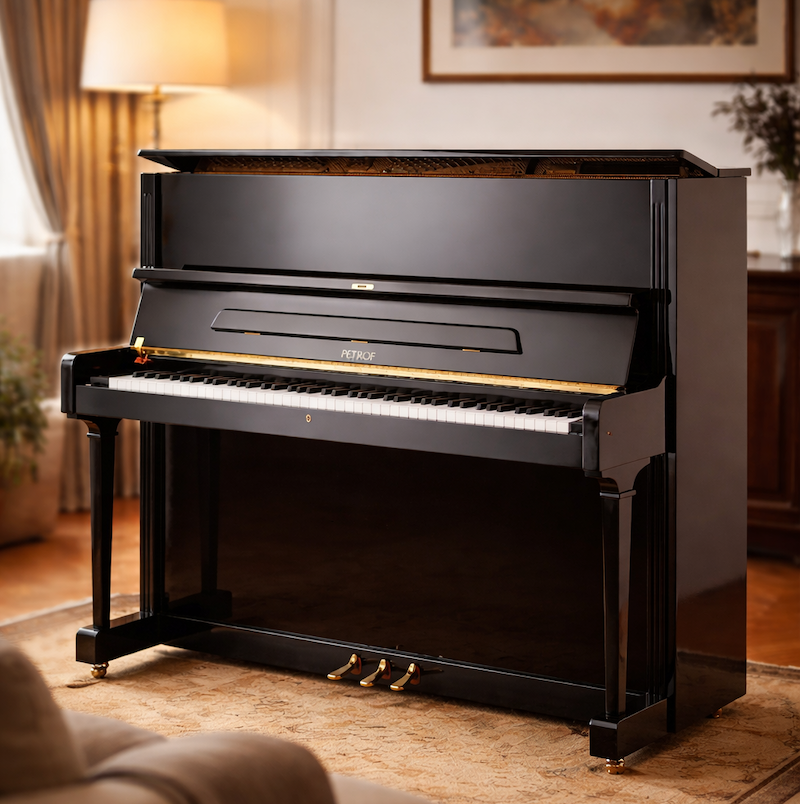
I didn’t fully understand what people meant by a “singing tone” until I spent time with the Petrof P125 G1.
On paper, it’s a 125 cm (49-inch) upright piano, built in Europe by Petrof—a company with roots dating back to 1864 and a long-standing presence in European musical life. But none of that quite prepares you for what it feels like to actually sit down and play. If you’re exploring how different piano builds influence tone, it’s worth reading our guide to upright vs grand pianos here.
The first thing I noticed wasn’t power or brilliance. It was how the sound lingered—as if each note had something more to say after it was played.
A Different Kind of Voice
Some piano projects. Some sparkle. The P125 G1 does something quieter—and perhaps more difficult—it sings. There’s a softness to the attack, followed by a warmth that blooms through the middle of the tone. It doesn’t rush forward or try to impress with brightness. Instead, it draws you in, especially when you give the music space.
If you’re curious about how tonal character differs across brands, you might also enjoy our overview of European vs Japanese pianos here.
I found this especially revealing when playing composers like Frédéric Chopin or Claude Debussy. On many pianos, you work to shape the line. Here, the line seems to emerge more naturally, as if the instrument is meeting you halfway. There’s also a subtle complexity in the sound—layers of overtones that give even simple passages depth. Not heavy, not overly bright, but rounded and resonant in a way that feels quietly orchestral.
A Voice That Adapts With the Music
It’s often described as having a “romantic” tone, but that can be misleading if taken too narrowly. What becomes more apparent over time is its ability to carry colour and depth across different kinds of repertoire. The warmth is always there, but so is enough clarity to support more complex textures.
Music by Frédéric Chopin or Claude Debussy feels immediately at home, where nuance and phrasing take center stage. But the piano doesn’t feel limited when moving into the broader, more expansive writing of Sergei Rachmaninoff or Pyotr Ilyich Tchaikovsky. You approach that repertoire a little differently—not by forcing brightness or sheer volume, but by building sound through weight, layering, and resonance. The result leans toward richness rather than brilliance, yet remains full and satisfying.
For more on choosing the right piano for your repertoire and playing style, see our piano buying guide here.
Growing With the Player
One of the most surprising things about the P125 G1 is how naturally it supports different stages of playing. At a beginner level, it feels approachable. The tone softens unevenness, and the action responds without resistance, allowing you to focus less on control and more on listening.
If you’re just starting out, our beginner piano guide is a helpful place to start: https://www.tomleemusic.ca/blog/best-pianos-for-beginners
As your playing develops, those same qualities begin to open up. Soft dynamics become more expressive. The connection between notes becomes clearer. You begin shaping phrases with intention, rather than simply producing sound. It’s rare to find an instrument that doesn’t feel temporary at any stage. This one doesn’t present itself as something to outgrow—it’s something you grow into.
A Quiet Presence in Teaching Spaces
Pianos from Petrof have long been part of the musical landscape in Europe, particularly in environments where tone and expression are central to teaching. That presence reflects a different philosophy. Rather than emphasizing projection or uniformity, the focus leans toward developing a sense of line, colour, and musical sensitivity from the beginning.
If you’re interested in how the environment impacts learning, you might find this article useful here.
A piano like this supports that approach. It encourages close listening, connected phrasing, and an awareness of sound as something shaped over time. In that way, it feels less like a practice tool and more like a partner in learning how to hear.
Living With the Sound
What stayed with me most is how naturally the piano fits into a space. It doesn’t dominate a room—it settles into it. The sound carries, but in a way that feels organic—never harsh, never forced in a home setting, which makes a difference.
If placement matters to you, this guide on piano placement and care is helpful here.
Whether practicing quietly in the evening or playing for a small group, the tone remains present without overwhelming. Over time, it even changes how you play. You use less force, listen more, and allow phrases to unfold rather than pushing them forward.
Craft and Character
There’s also something reassuring in how it’s built. Carefully prepared materials and traditional construction methods don’t call attention to themselves, but you feel them in the consistency of touch and stability of tone.
To learn more about how pianos are built, explore here.
Visually, the G1 model leans toward understated elegance. It doesn’t try to stand out—it simply belongs, whether in a contemporary home or a more traditional setting.
A Different Kind of Longevity
Some pianos are designed to impress immediately. Others reveal themselves more slowly. The P125 G1 belongs to the latter. It doesn’t rely on brightness or projection to make an impression. Instead, it offers a smoother, richer sound that deepens over time. The more attention you give to tone and phrasing, the more it gives back.
An Invitation to Listen
In the end, what makes this piano memorable isn’t a single feature—it’s the way it shapes your attention. You begin by noticing the warmth. Then the connection between notes. Then the space between phrases. And somewhere along the way, almost without realizing it, you start listening differently.
Explore the Petrof P125 G1 here.
On sale now as part of our Fiscal Year End Piano Sale.
Find your nearest showroom:
https://www.tomleemusic.ca/storelocation
Visit Tom Lee Music and experience the unmistakable romantic voice of Petrof.