

RUPERT NEVE DESIGNS 5025 | Dual Shelford Mic Preamp

- Catalog #: 5025
5025
Dual Shelford Microphone Preamp
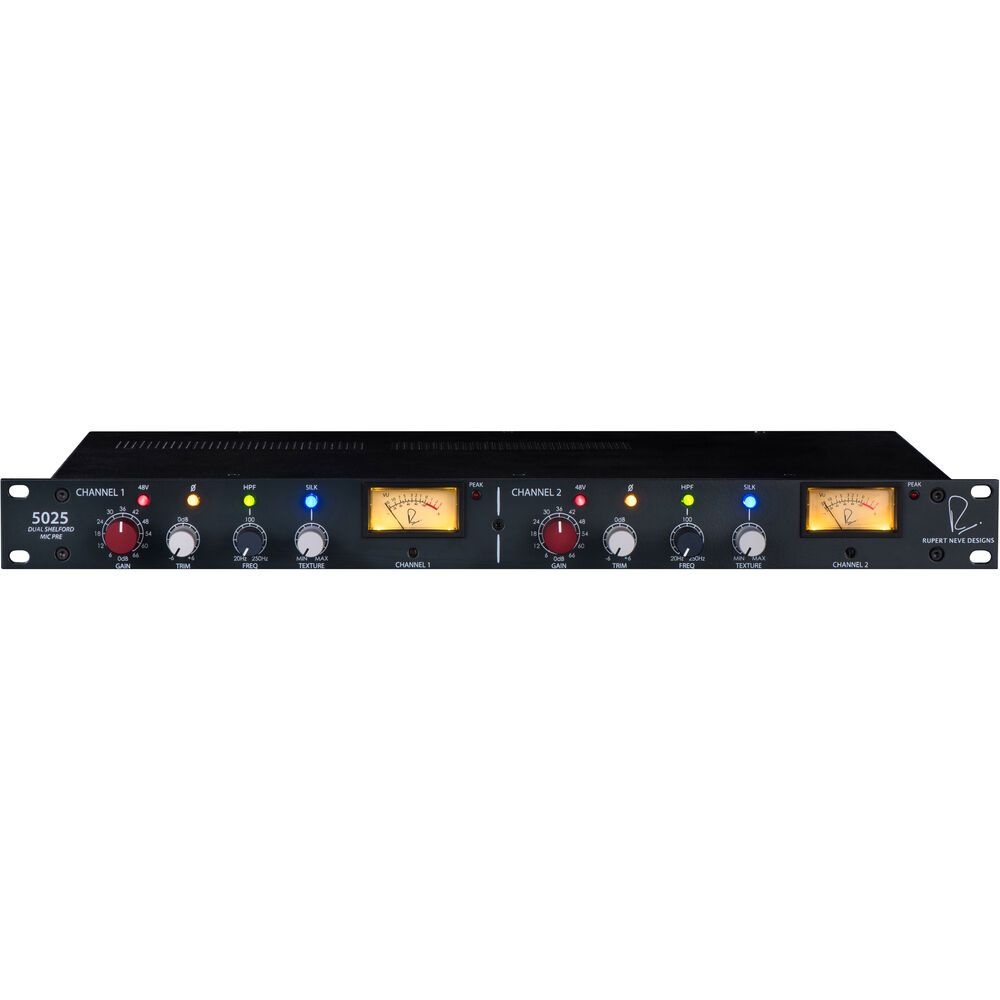
Packing two channels of flagship preamplification into a single rack space for engineers and musicians who demand the best, the Rupert Neve Designs 5025 Dual Shelford Microphone Preamp combines the sweet musicality of highly desired vintage Neve modules with greatly extended bandwidth and sonic versatility ranging from refined transparency to heavy-handed harmonic saturation. With up to 72 dB of gain available, including 15 dB from a custom step-up transformer and up to 6 dB via the trim knob, the Dual Shelford is a perfect companion for any mic, even low-output ribbons and dynamic mics of old.
Dual output level transformers are paired with main and -6 dB outputs to allow pristine sound at high levels or the characterful coloration of a hard-driven preamp without clipping the next stage of the signal chain. The inclusion of Rupert Neve Designs' Silk circuit offers adjustable harmonic enhancement in two modes—Red imparts sparkle and presence to the highs, while Blue thickens the lows and low mids to add weight. Finished with a worldwide power supply inside and attractive analog VU meters on its face, the 5025 Dual Shelford is destined to be a studio favorite and collector's prize for years to come.
Dual Channel Flagship Preamplifier
RND's best-selling Shelford Channel is the definitive evolution of the original technologies in Rupert Neve's classic modules like the 1073, 1064, and 2254, thoughtfully advanced and refined for the 21st century.
By popular demand, RND introduced the Dual Shelford Mic Pre: a two-channel version of their flagship preamplifier that has become an indispensable tool for countless engineers and musicians. The Dual Shelford offers the sonic excellence of two Rupert Neve Designs Shelford mic preamps in a single rack space with an internal power supply.
Transformer-Gain Mic Pre
Like Rupert's designs from his time in Little Shelford, the Dual Shelford uses a custom step-up transformer on the mic input to provide the first 15 dB of gain. This specially designed transformer, along with its careful integration with the surrounding Class-A circuitry, is critical to the amplifier's bold, mid-focused magic that can be heard on thousands of classic recordings.
While creating the input stage for the Shelford Channel and Dual Shelford pre, the goal was not merely to recreate the classic designs, but to advance them: combining the unmistakable sound of vintage technology with wide-bandwidth frequency response, consistently excellent amplifier performance at any gain setting, and extremely low-noise operation. The resulting preamplifier is flat from below 10 Hz to above 60 kHz, yielding pure tone and high levels of versatility.
Silk and Texture
The exclusive Silk and Texture circuit on the Dual Shelford allows you to fine-tune the amount and type of harmonic content in the output stage. This means your signal can be adjusted from quite transparent to settings that produce nearly ten times the amount of sonic color as Rupert's vintage modules.
The Red mode enhances harmonic content generated by the highs and high-mids of your source, yielding a sparkly sheen that complements vocals, snare, strings, pianos, and other acoustic instruments. With the Blue mode, you're enhancing harmonic content generated by the lows and low-mids of your source, imparting beefy tone that's often ideal for drums, bass guitar, heavy electric guitars, male vocals, and synths.
Dual Output Level Transformers
Complementing the Silk circuit are the custom-designed output transformers, which use Rupert Neve Designs' distinctive dual-output topology. These offer both main (+26 dBu) and -6 dB (+20 dBu) XLR outputs, allowing the engineer to drive the preamps fully into classic transformer saturation without clipping converters and other devices later in the chain.
The main outputs are designed to capture a more pristine sound at high levels, avoiding any nonlinear coloration of the output stage. The -6 dB outputs allow an engineer to fully drive the Shelford—adding dynamic tone with these same nonlinear colorations—without clipping most professional interfaces. On drums, vocals, guitars, and other instruments, these outputs let you easily hit the transformer's sweet spot of nonlinear harmonic content, bringing a recorded performance to life.
- Definitive evolution of Rupert Neve's renowned vintage mic preamp technology
- Custom transformer-gain mic preamp features a distinctly musical response
- Dual output level transformers create rich harmonic character without clipping the next device in the chain
- Silk Red and Blue modes with Texture control to precisely dial in the desired amount of classic tone
- Shelford circuitry delivers the essence of classic designs coupled with updated versatility
- Up to 72 dB of low-noise, Class-A gain to bring out the best in any source
- Variable high-pass filter from 20 to 250 Hz
- Analog VU meters provide classic metering style and vibe
- Worldwide power supply with double the voltage of the original 80 Series modules
- Precision-engineered discrete design, built for decades of use
Specifications
- Number of Channels
- 2
- Inputs
- 2 x XLR 3-Pin Female Mic Inputs (Balanced, Locking)
- Outputs
- 2 x XLR 3-Pin Male Line Outputs (Balanced)
- 2 x XLR 3-Pin Male Line Outputs (Balanced, -6 dB)
- Frequency Response
- 20 Hz to 20 kHz (±0.25 dB)
- 10 Hz to 62 kHz (±0.5 dB)
- 5 Hz to 70 kHz (-3 dB)
- THD + N
- <0.0025% at 1 kHz (0 dBu Input, 10 Hz to 90 kHz Bandwidth)
- <0.008% at 1 kHz, (+20 dBu Input, 10 Hz to 90 kHz Bandwidth)
- Noise
- Main Output at 0 dB Gain: -102 dBu (22 Hz to 22 kHz Bandwidth)
- Main Output at +30 dB Gain: -94 dBu (22 Hz to 22 kHz Bandwidth)
- Main Output at +66 dB Gain: -61 dBu (22 Hz to 22 kHz Bandwidth)
- -6 dB Output at 0 dB Gain: -107 dBu (22 Hz to 22 kHz Bandwidth)
- -6 dB Output at +30 dB Gain: -100 dBu (22 Hz to 22 kHz Bandwidth)
- -6 dB Output at +66 dB Gain: -67 dBu (22 Hz to 22 kHz Bandwidth)
- Equivalent Input Noise
- Main Output at +66 dB Gain: -127 dBu
- -6 dB Output at +66 dB Gain: -133 dBu
- Gain Range
- Gain: +6 to +66 dB
- Trim: -6 to +6 dB
- Maximum Input Level
- +24.9 dBu at 1 kHz
- +26.7 dBu at 1 kHz (Main Output)
- +20.7 dBu at 1 kHz (-6 dB Output)
- Input Impedance
- 2.2 Kilohms
- Phantom Power
- +48 VDC
- Filter Type
- High-Pass Filter
- Frequency Band
- 20 Hz to 250 Hz
- Power Requirements
- 100 to 240 VAC, 50/60 Hz
- Power Consumption
- 45 W
- External Dimensions (W x D x H)
- 19.0 x 9.2 x 1.8" / 48.3 x 23.4 x 4.4 cm
In The Box
- Rupert Neve Designs 5025 Dual Shelford Microphone Preamp
- IEC Power Cable
- Limited 3-Year Manufacturer Warranty