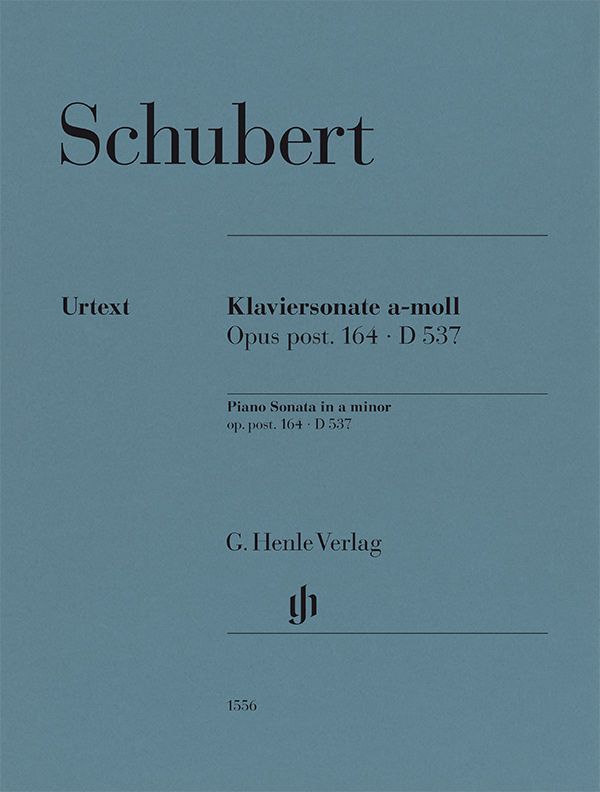


HENLE SCHUBERT Piano Sonata A Minor Op. Post. 164 D 537
$22.95
In Stock
SKU
241867
- Catalog #: 51481556
- DOMINIK RAHMER
- PIANO SOLO
Franz Schubert seems to have been particularly attracted to a-minor. Not just one but three of his piano sonatas are in this key. The earliest of them, D 537, was composed in March 1817 and was simultaneously his first completed piano sonata ever. It is characterised by concise brevity. The three-movement form dispenses with the usual scherzo. It is far removed from the drama of its a-minor sibling works; meandering modulations often lead to distant harmonic regions and lighten the mood to major – significantly, the sonata also ends in A major. Henle’s Urtext edition is based on the autograph, which is preserved in the Bibliothèque nationale in Paris; a contemporary manuscript copy and the posthumous first edition were only used for comparison purposes. The preface by Schubert expert Andrea Lindmayr-Brandl and the detailed comment section provide information about the work’s genesis and about open questions concerning the musical text. The fingerings by renowned Schubert interpreter Martin Helmchen are a further plus point of this new edition.
Dominik Rahmer (Editor)
Andrea Lindmayr-Brandl (Preface)
Martin Helmchen (Fingering)
Urtext Edition, paperbound
Piano solo
revised edition
replaces HN 697
Pages 24 (V+19), Size 23,5 x 31,0 cm
Weight 118 g
HN 1556 · ISMN 979-0-2018-1556-5
Write Your Own Review